
Date:2026-01-08
With the rapid adoption of biometric authentication in mobile payments, access control systems, smart security, and fintech applications, fingerprint recognition remains one of the most mature and widely deployed biometric technologies. When evaluating the performance of a fingerprint recognition system, FAR (False Acceptance Rate) and FRR (False Rejection Rate) are two critical metrics that are often underestimated by non-specialists but are essential in real-world deployments.
False Acceptance Rate (FAR)
FAR represents the probability that the system incorrectly accepts an unauthorized user. A high FAR indicates that the system is vulnerable to impersonation or spoofing attacks, posing a serious risk to system security.
False Rejection Rate (FRR)
FRR measures the probability that the system incorrectly rejects a legitimate user. An excessively high FRR negatively affects usability and user experience, especially in smart devices and enterprise access control scenarios.
In any fingerprint authentication system, FAR and FRR must be evaluated together to ensure both security and usability.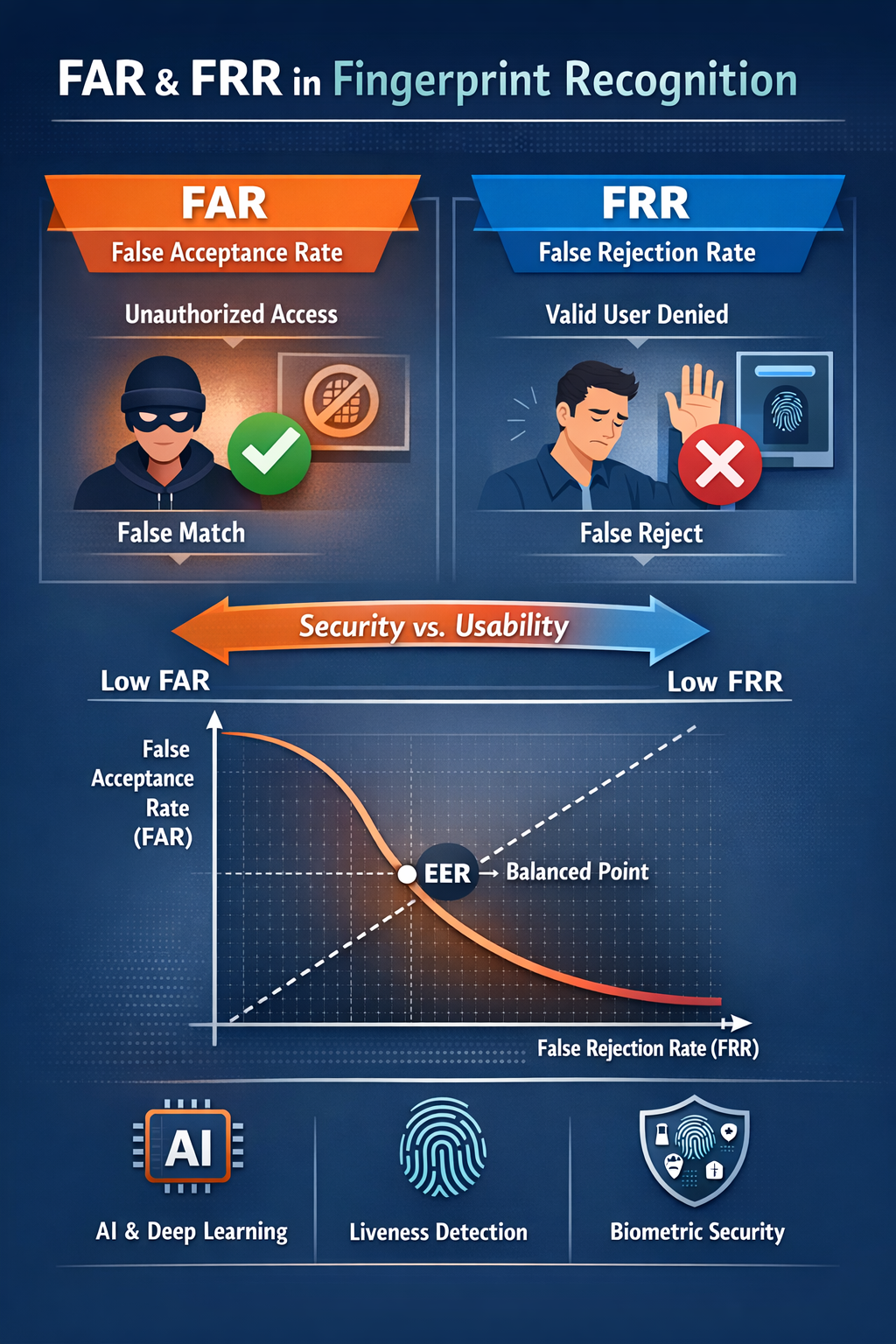
In high-security applications such as financial transactions, data centers, and restricted-access environments, maintaining a low FAR is the top priority. Even if a system offers fast recognition and smooth user interaction, a high FAR can result in:
Vulnerability to fake fingerprint attacks
Increased risk from replay attacks or database breaches
Reduced trust in liveness detection capabilities
As a result, FAR is widely used as a key benchmark when evaluating AI-based fingerprint recognition and deep learning–driven biometric systems. It is also closely aligned with international biometric standards such as ISO/IEC 19795.
While FAR focuses on security, FRR directly impacts system usability. In real-world deployments, FRR may increase due to:
Dry, wet, or dirty fingers
Fingerprint wear (e.g., manual labor workers)
Poor fingerprint acquisition or aging sensors
If FRR is too high, even a highly secure system can frustrate users, leading to repeated authentication failures and reduced trust in fingerprint login or biometric security solutions. Therefore, in consumer electronics and mobile authentication scenarios, FRR is closely tied to user satisfaction and product adoption.
In practice, FAR and FRR exhibit an inherent trade-off:
Increasing the matching threshold reduces FAR but increases FRR
Lowering the threshold reduces FRR but increases FAR
This trade-off explains why modern machine learning–based fingerprint recognition systems employ advanced techniques such as:
Multi-feature fusion (e.g., minutiae and texture features)
Adaptive thresholding
Liveness detection and multi-modal biometric authentication
These approaches help achieve an optimal balance among accuracy, security, and user experience.
Whether during the development of a fingerprint recognition algorithm or its deployment in payment systems, access control, and smartphones, FAR and FRR remain indispensable evaluation metrics. They not only reflect the technical maturity of a biometric system but also determine its real-world security and usability.
As AI, deep learning, and biometric security technologies continue to evolve, precise control and optimization of FAR and FRR will remain central to the future of fingerprint recognition.

Tel:0755-33581519
Fax:0755-33581529
粤ICP备17061059号  粤公网安备 44030502005031号

 中文
中文